Basic Definitions for Planet Module
[All Implemented Hooks]
Main user interface.
More...
Collaboration diagram for Basic Definitions for Planet Module:

|
Functions | |
| planet_perm () | |
| Implementation of hook_perm - Defines user permissions. | |
| planet_help ($path, $arg) | |
| Implementation of hook_help - Provides online user help. | |
| planet_menu () | |
| Implementation of hook_menu() - Defines menu items and page callbacks. | |
Detailed Description
Main user interface.Function Documentation
| planet_help | ( | $ | path, | |
| $ | arg | |||
| ) |
Implementation of hook_help - Provides online user help.
- Parameters:
-
$path A Drupal menu router path the help is being requested for $arg
- Returns:
- A localized string containing the help text.
00054                                   {
00055   switch ($path) {
00056     case 'admin/help#planet':
00057       // The module's help text, displayed on the admin/help page and through the module's individual help link.
00058       $output = '<p>Planet is an aggregator that allows you to aggregate your users blogs and to display them in a "planet" fashion. Associating content with the users rather than as a detached feed.</p>';
00059       $output .= '<p>To use planet, go to admin/settings/planet and note the following sections:</p>';
00060       $output .= '<ul>';
00061       $output .= '<li><strong>General Settings</strong>. The filter format drop down will allow you to select the filter format that will be used to show planet entry nodes.</li>';
00062       $output .= '<li><strong>Feeds</strong>. This section lets you add a new feed. Give it a title, select an author, provide the feed url, and you\'re off. You\'ll have to manually refresh it or wait for a cron run for items to be imported.</li>';
00063       $output .= '<li><strong>Feeds</strong>. This section lists current feeds, when they were last updated, how many items they have, and it allows you to edit, refresh, or freeze them. Freezing is a quick way to temporarily suspend updates from the given feed.</li>';
00064       // @DIFFGROUP output syntax
00065       $output .= '</ul>';
00066       return $output;
00067       // @DIFFINFO in D6, admin/modules#description is moved to .info file
00068   }
00069 }
| planet_menu | ( | ) |
Implementation of hook_menu() - Defines menu items and page callbacks.
- Returns:
- An array of menu items. Each menu item has a key corresponding to the Drupal path being registered.
@Invokes: planet_user_feeds() ( through page callback() )
@Invokes: planet_page_user() ( through page callback() )
@Invokes: planet_call_refresh() ( through page callback() )
@Invokes: planet_toggle_frozen() ( through page callback() )
@Invokes: planet_page_last() ( through page callback() )
@Invokes: planet_feed() ( through page callback() )
This diagram shows how requests are handled. Each arrow is labeled with the permission required to access link. The menu item colors reflect the item type. 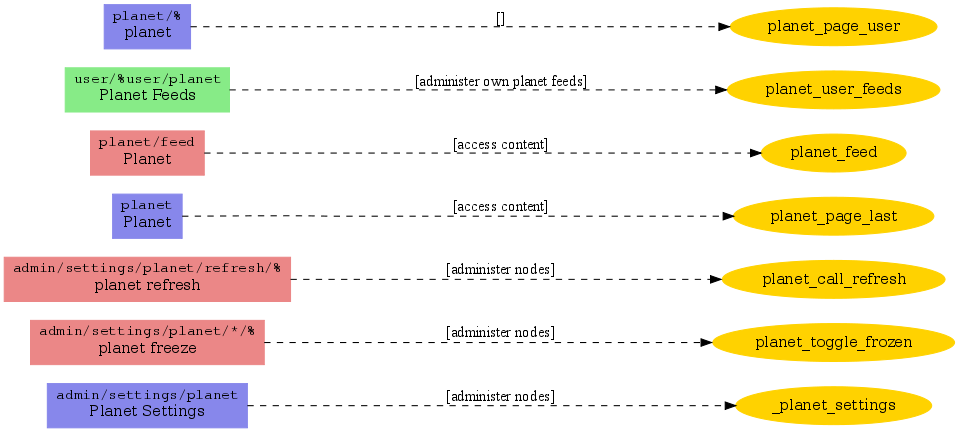
Menus and Pages
00150                        {
00151   $items['admin/settings/planet'] = array(
00152     'title' => 'Planet Settings',
00153     'description' => 'Configure settings for the planet module.',
00154     'page callback' => '_planet_settings',
00155     'access arguments' => array('administer nodes'),
00156     'type' => MENU_NORMAL_ITEM);
00157
00158   $items['user/%user/planet'] = array(
00159     'title' => 'Planet Feeds',
00160     'page callback' => 'planet_user_feeds',
00161     'page arguments' => array(1),
00162     'access arguments' => array('administer own planet feeds'),
00163     'type' => MENU_LOCAL_TASK,
00164   );
00165
00166   //  if (arg(0) == 'planet' && is_numeric(arg(1))) {
00167   // FIXME access denied http://localhost/drupal/?q=planet/1
00168   $items['planet/'. '%'] = array(
00169     'title' => 'planet',
00170     'page callback' => 'planet_page_user',
00171     'page arguments' => array(arg(1))
00172   );
00173
00174   //   if (arg(3) == 'refresh' && is_numeric(arg(4))) {
00175   $items['admin/settings/planet/refresh/%'] = array(
00176     'title' => 'planet refresh',
00177     'page callback' => 'planet_call_refresh',
00178     'access arguments' => array('administer nodes'),
00179     'type' => MENU_CALLBACK
00180   );
00181
00182   //  if (is_numeric(arg(4)) && (arg(3) == 'freeze' || arg(3) == 'unfreeze')) {
00183   $items['admin/settings/planet/'. arg(3) .'/%'] = array(
00184     'title' => 'planet freeze',
00185     'page callback' => 'planet_toggle_frozen',
00186     'access arguments' => array('administer nodes'),
00187     'type' => MENU_CALLBACK
00188   );
00189
00190   $items['planet'] = array(
00191     'title' => 'Planet',
00192     'description' => 'Planet Page',
00193     'page callback' => 'planet_page_last',
00194     'access arguments' => array('access content'),
00195     'type' => MENU_NORMAL_ITEM
00196   );
00197
00198   $items['planet/feed'] = array(
00199     'title' => 'Planet',
00200     'page callback' => 'planet_feed',
00201     'access arguments' => array('access content'),
00202     'type' => MENU_CALLBACK
00203   );
00204
00205   return $items;
00206 }
Here is the call graph for this function:

| planet_perm | ( | ) |